Expertise

Build the measurement chain around the instrument.

NeuralSoftX connects specimen modelling, physical simulation, inverse methods, scientific machine learning and high-performance software. The method can be classical, neural or hybrid; it is selected only after the measurement and its operating domain are defined.

  • SEM, TEM and STEM imaging
  • Diffraction, CBED and 4D-STEM
  • Tomography, ptychography and exit waves
  • EELS, EDX and scattering workflows
  • CPU, GPU, offline and on-premise delivery

Complete technical workflow

Generation, solution development and validation remain one controlled system.

The stages are adapted to the project, but their scientific roles remain separate. Calibration identifies the measurement generator, training optimises a learned solution, and validation tests the completed workflow on independent evidence.

  1. 01

    Define the domain

    Specify specimens, instruments, signals, acquisition conditions, targets, deployment limits and acceptance criteria.

  2. 02

    Partition evidence

    Separate data allowed for calibration and adaptation from held-out measurements reserved for validation.

  3. 03

    Engineer the generator

    Build or extend the specimen, interaction, optics, detector, scan, noise and target-generation stages.

  4. 04

    Calibrate and generate

    Match task-relevant observables, then generate controlled observations, targets and metadata across the required coverage.

  5. 05

    Develop candidates

    Train or fine-tune neural models where justified and compare classical, numerical and hybrid alternatives.

  6. 06

    Select for deployment

    Measure accuracy, latency, throughput, memory, image-size behaviour and integration constraints.

  7. 07

    Validate independently

    Test each contracted coverage cell with held-out acquisitions, known-truth cases, references and failure analysis.

  8. 08

    Package and accept

    Deliver data, weights, a stand-alone method or a complete system with limits, evidence and handover material.

Scientific distinction: physical and statistical generators are calibrated; learned solutions are trained or fine-tuned; completed workflows are validated.

01 / Physical foundations

Model the specimen, instrument and signal.

A simulation is useful only when its fidelity is allocated according to the requested measurement. NeuralSoftX models the factors that control the target and uses validated approximations for variations that do not justify full physical expense.
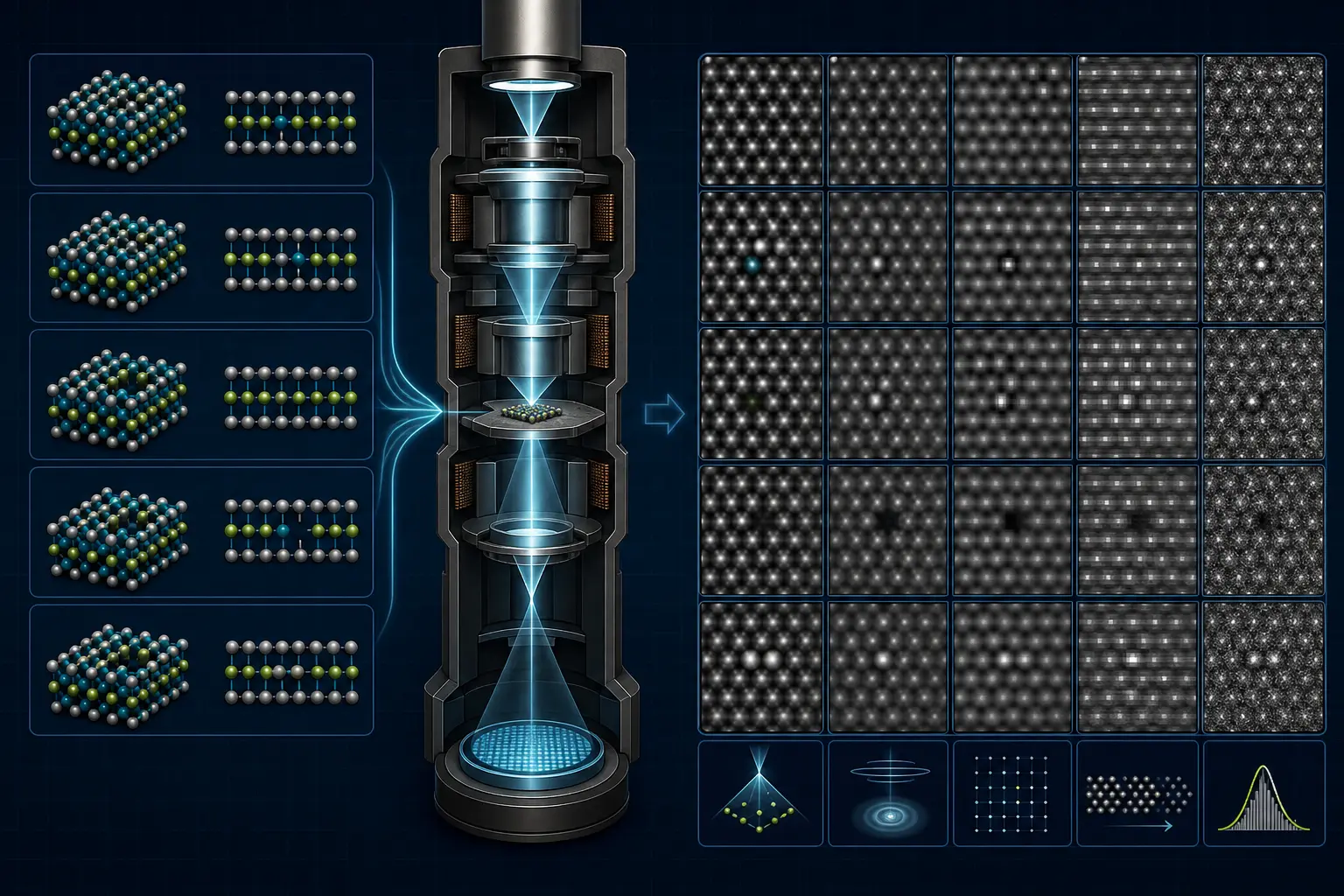
Illustrative top-to-bottom electron-beam simulation connecting atomistic specimen variations to controlled simulated microscopy images

Specimen and molecular modelling

Crystals, interfaces, defects, particles, amorphous material, molecular structures, thermal displacement and project-dependent molecular dynamics.

Forward simulation

Electron–specimen interaction, optics, coherence, detector geometry, dose, noise, drift, vibration and scan behaviour.

Controlled ground truth

Exact labels, clean targets, physical quantities and metadata for calibration, development and benchmarking.

System identification

Calibrate the generator against representative client data using task-relevant observables rather than appearance alone.

Transmission-electron workflows can use accurate multislice foundations where appropriate. SEM and adjacent modalities are modelled separately according to their own signal physics; they are not presented as MULTEM capabilities.
02 / Data and solution development

Calibrate the generator. Train the solution.

After the measurement domain is defined, representative experimental data are divided by purpose. Calibration data identify the measurement signature and support generator calibration or permitted model adaptation. Held-out data remain separate for experimental validation.

The calibrated generator then produces controlled observations, exact targets and metadata across the contracted coverage. Neural networks are trained or fine-tuned only where they are justified; classical, statistical and physics-based candidates remain available and provide reference methods where practical.

Dataset production

Generate paired images and targets, labels, physical quantities, clean references and metadata with explicit specimen–instrument–signal coverage.

Training and fine-tuning

Optimise task-specific neural estimators using synthetic data, synthetic pretraining plus experimental adaptation, or another justified evidence design.

Candidate comparison

Compare classical, numerical, neural and hybrid routes against scientific accuracy, robustness, traceability and failure behaviour.

Multi-domain design

Evaluate separate specialised models, conditional models, shared backbones with instrument adapters or validated routed ensembles.

Deployment-aware selection

Select accuracy, balanced, fast, CPU or large-image variants against measured latency, memory, throughput and boundary consistency.

Purchasable outputs

Controlled synthetic data from the calibrated generator, trained weights and inference, a stand-alone non-neural method, or the complete validated workflow.

Scientific distinction: physical and statistical generators are calibrated. Learned solution models are trained or fine-tuned. The completed system is validated using evidence not used for either activity.

03 / Correction and registration

Recover a trustworthy measurement before interpretation.

Small positional or acquisition errors can dominate high-resolution measurements. Correction is therefore treated as part of the quantitative pipeline rather than a cosmetic preprocessing step.

Restoration

Single-shot low-dose restoration, detector-effect correction and composite geometric or photometric degradation.

Registration

Rigid and non-rigid alignment for repeated scans, time series, mosaics, focal series and tilt series.

Acquisition correction

Drift, jitter, vibration, fast-scan artefacts, scan distortion and diffraction-pattern centring.

Quantitative safeguards

Acceptance criteria tied to the scientific target, not merely to visual sharpness or subjective image quality.

04 / Tomography

Build the complete path from projections to 3D structure.

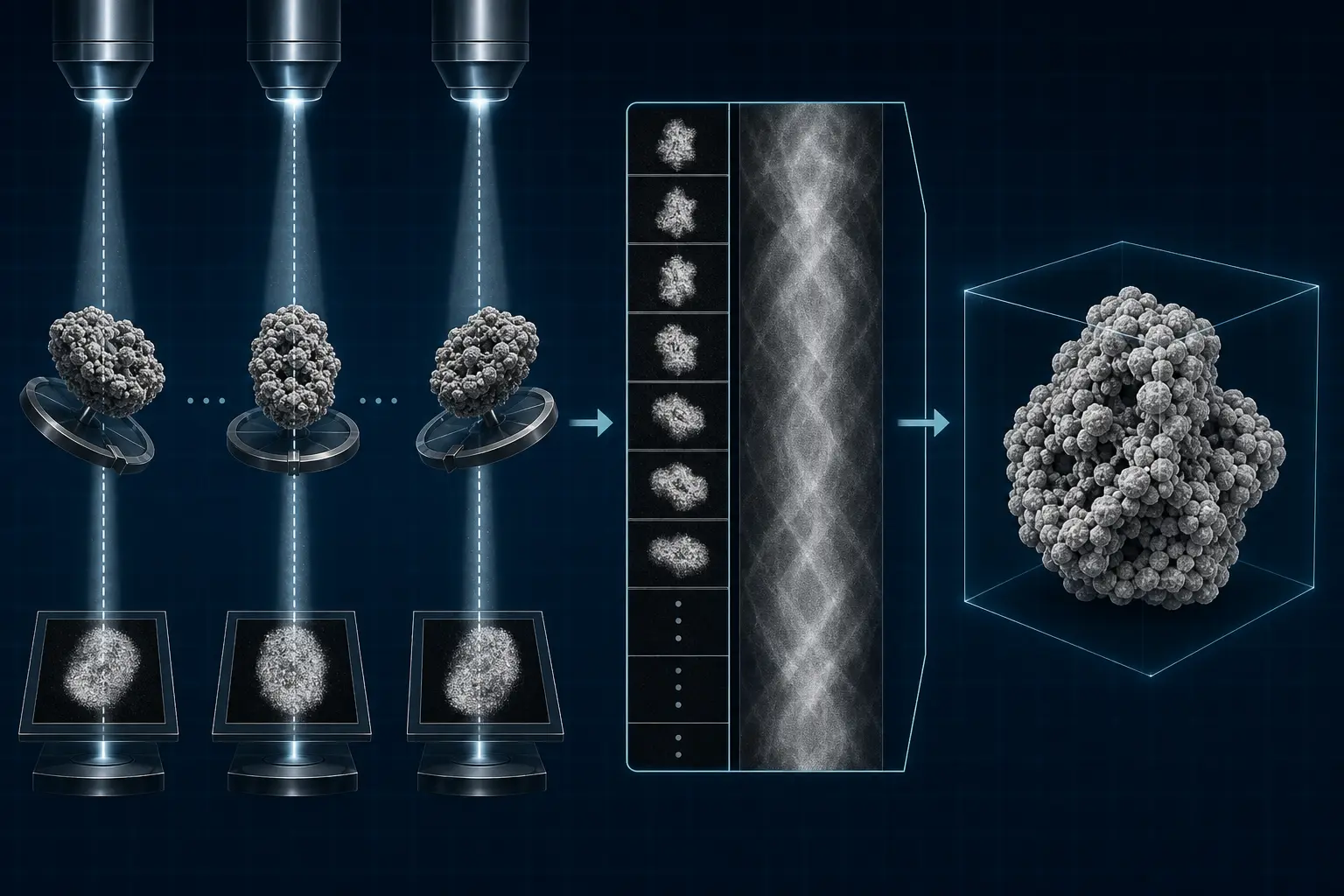
The workflow can cover projection quality control, coarse and fine alignment, tilt-axis and acquisition-geometry estimation, analytical or iterative reconstruction, physical constraints, consistency assessment and quantitative interpretation.

Illustrative electron tomography sequence with a specimen tilted beneath a top-down beam, corresponding projections and recovery of the same three-dimensional object

Sparse and limited angle

Projection conditioning, sinogram interpolation, artefact reduction, regularisation and uncertainty-aware interpretation.

Quantitative and atomic

Forward models, statistical atom counting, physical priors, atomicity constraints and numerical optimisation where the evidence supports them.

A tomography solution may be entirely non-neural when traceability, physical constraints or client policy make that the stronger route.

05 / Ptychography and exit waves

Active development

Reconstruct the complex wave—not only image intensity.

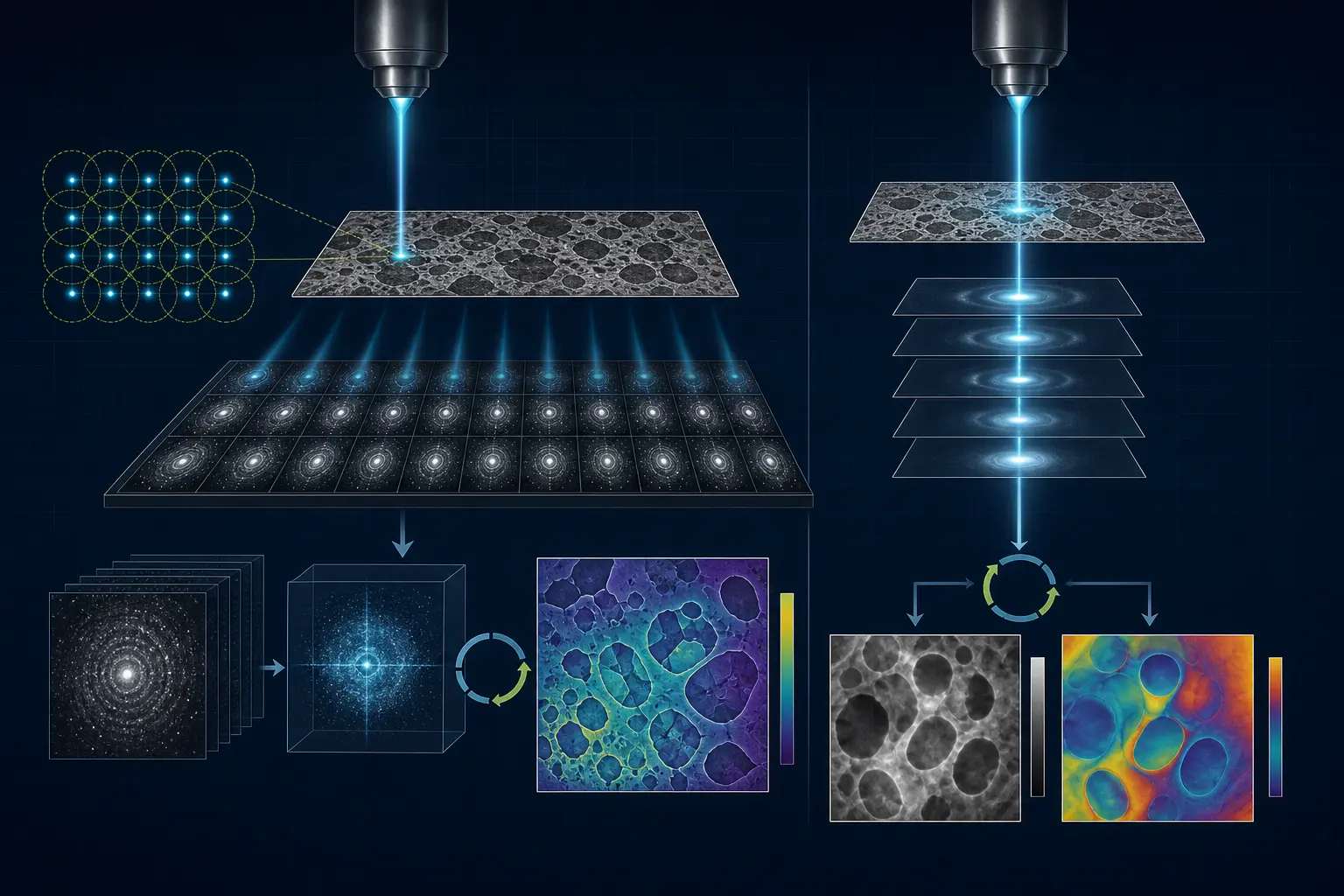
NeuralSoftX is independently implementing and packaging new ptychography and exit-wave systems. They are available for technical discussion and development partnerships, while full validation and productisation continue.

Illustrative top-to-bottom ptychography and focal-series workflows producing complex phase and amplitude reconstructions

Ptychography and 4D-STEM

Detector and CBED preprocessing, centring, probe and aberration initialisation, thin-object or multislice reconstruction, and joint object, probe and position refinement.

Exit-wave reconstruction

Focal-series conditioning, alignment, aberration and coherence modelling, complex amplitude and phase recovery, simulation comparison and consistency assessment.

General exit-wave model

A broad neural model intended to cover many microscope and acquisition settings without client-specific retraining.

Instrument-adapted model

A narrower system calibrated and retrained for the client's microscope, detector, specimen family and acquisition protocol.

Maturity note: the neural exit-wave system remains under active development. It is not described as a fully validated commercial product until its evidence record is complete.

06 / Measurement and analysis

Extract the quantity the scientific decision requires.

Detection and segmentation are not generic services. Each problem needs its own label definition, coverage, architecture or classical method, metrics and review interface.

Detection and localisation

Atom columns, particles, nanoparticles, defects, voids and application-specific structures.

Segmentation

Cracks, fibres, inclusions, phases, grains, domains and microstructural regions.

Spectroscopy and scattering

Simulation, learned surrogates, registration, denoising and larger quantitative EDS, EELS or cross-section workflows when evidence is sufficient.

Quantitative outputs

Atom positions, particle statistics, restored or corrected images, calibrated simulators, synthetic datasets and other contracted measurements.

07 / Scientific software

Transfer a working system with known limits.

Architecture and packaging are selected against the complete deployment envelope: latency, throughput, CPU or accelerator, memory, image dimensions, tiling, precision, operating system and integration interface.

Implementation

C++, CUDA and Python; reproducible numerical pipelines; ONNX or another justified deployment representation.

Operating modes

Local, offline, on-premise or remote; batch, tiled, streaming or interactive processing.

Delivery variants

Accuracy, balanced, fast, CPU and memory-controlled large-image configurations where useful.

Handover

Operating-domain statement, validation report, known limitations, installation material, integration guidance and acceptance results.

08 / Validation

Establish where the result is fit for purpose.

Representative experimental data are required before a solution is described as validated for a client's measurement domain. Calibration data tune the generator; held-out data test transfer to unseen experimental measurements.

  • Known-truth synthetic benchmarks and established reference methods
  • Held-out experimental consistency and repeat acquisitions where available
  • Resolution, stability and sensitivity assessment
  • Explicit failure, out-of-domain and deployment analysis
  • Independent validation of every contracted coverage cell

Deliverable levels

Use existing technology or build what is missing.

Clients may buy synthetic data, trained weights and inference, a stand-alone non-neural method, or a complete validated generation-to-deployment workflow.

General

Existing documented domain

Available only where a concrete package, licence and supported evidence domain already exist.

Instrument-adapted

Calibrated to the instrument

Existing NeuralSoftX-controlled technology adapted and validated for the client's defined domain.

Custom

New workflow

New simulation, algorithms, architectures or integration for an unsupported measurement problem.

Availability rule: these are scope levels, not a claim that every capability is already an off-the-shelf product. Tomography, ptychography and neural exit-wave systems retain their active-development status until their evidence and packaging gates close.

A concrete first step

Define the measurement, representative data and operating constraints.

Discuss feasibility